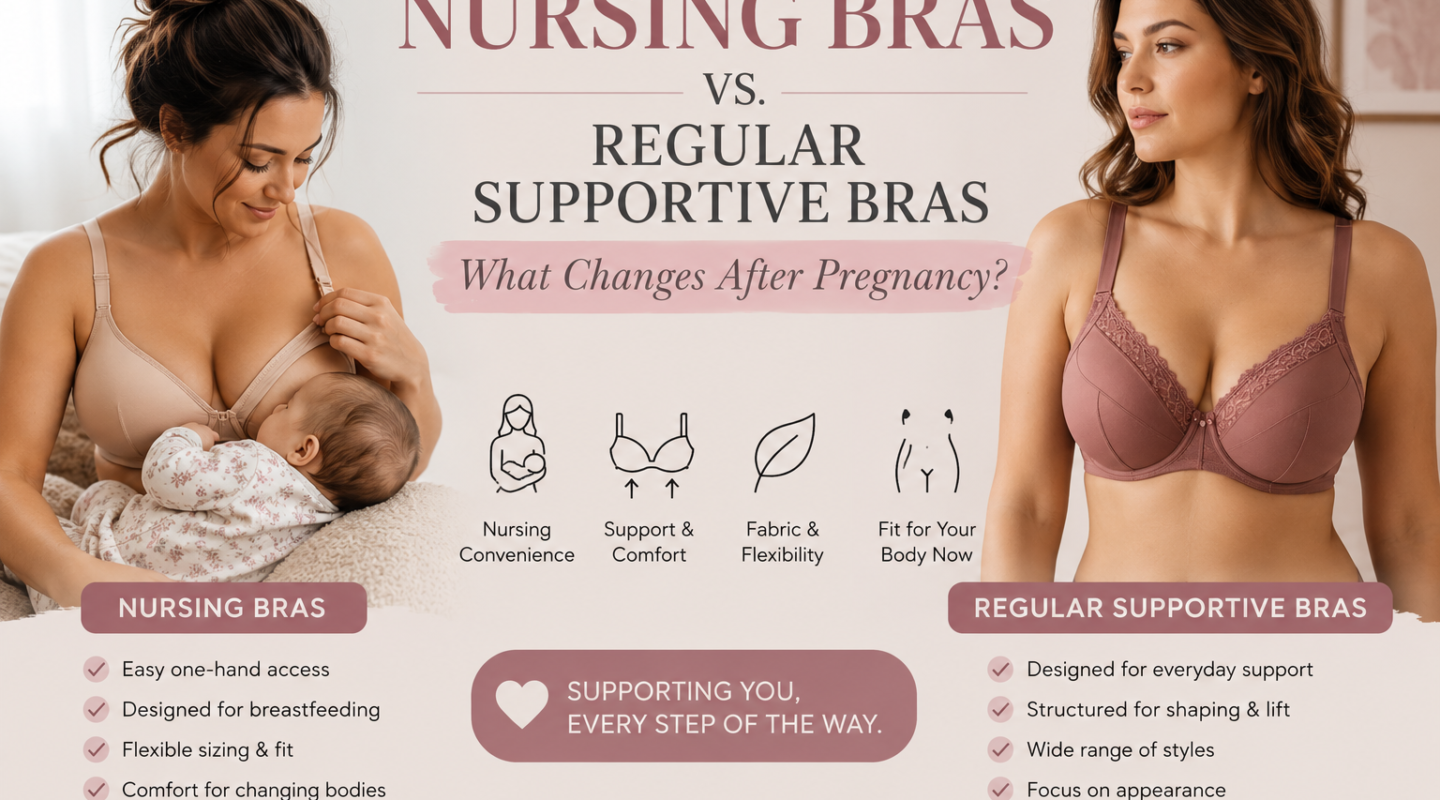
Pregnancy and the postpartum transition bring a whirlwind of body changes, but few areas experience as dramatic a transformation—literally overnight—as your bust.
When you’re packing your hospital bag or trying to get dressed a few weeks postpartum, it’s tempting to wonder: Do I really need to buy dedicated nursing bras, or can I just make my comfortable regular underwire and wireless bras work?
While a great regular bra is engineered to hold static breast tissue in place, postpartum breasts are anything but static. From fluid fluctuations and engorgement to sudden cup-size jumps and sensitive skin, your post-pregnancy body has completely different structural needs.
Here is a breakdown of what actually changes after pregnancy, how nursing bras differ from regular lingerie, and when it’s finally safe to transition back into your favorite everyday bras.
Quick Summary: The Postpartum Bra Shift (TL;DR)
The Big Difference:
Regular supportive bras are built with rigid frames, fixed cup volumes, and supportive underwires to shape static tissue. Nursing bras are engineered with flexible stretch fabrics, easy drop-down clips, side-sling supports, and wire-free frames that expand and contract throughout the day as your milk supply fluctuates.
First 0–6 Weeks Postpartum: Stick exclusively to soft, wire-free nursing bras or sleep bralettes (prevents blocked ducts and mastitis).
6+ Weeks Postpartum: Transition into structured nursing bras with drop-down clips as your milk supply regulates.
Post-Weaning: Get professionally remeasured before buying regular lingerie, as root shape and density will have shifted!
4 Major Body Changes After Pregnancy (And Why Regular Bras Fail)
To understand why traditional bras feel uncomfortable—and can even be harmful—postpartum, it helps to look at the anatomy:
1. Constant Volume Fluctuations
During nursing or pumping, your breast volume changes constantly. You might be a full F-cup before a morning feed and drop to an E-cup immediately after. A regular molded or foam-lined bra cannot contract with you; it will either overflow when you’re full or gap awkwardly when you empty.
2. Ribcage Expansion
During pregnancy, your ribcage expands outward to make room for baby—often adding 2 to 4 inches to your band size. Postpartum, it takes weeks (or months) for the ribs and cartilage to settle back to their baseline. The rigid band of a standard bra will pinch and dig into expanding/contracting rib tissue.
3. Shift in Tissue Density
Pregnancy hormones cause glandular tissue to expand rapidly. Post-weaning or postpartum, breast tissue often loses some of its former firmness, becoming softer and settling lower on the chest wall. Regular bras with low plunge center-vamps may cause softer tissue to spill over the middle.
4. Risk of Blocked Ducts & Mastitis
Rigid metal underwires in standard bras press directly into the tissue along the sides and underside of the breast. When milk glands are active, this localized pressure can restrict milk flow, leading to painful clogged ducts or mastitis (an infection of the breast tissue).
Nursing Bras vs. Regular Bras: Feature Comparison
The Anatomy of a High-Performance Nursing Bra
When you inspect a high-end nursing bra, you’ll spot several clever engineering features designed to keep you supported while accommodating your baby:
-
One-Handed Nursing Clips: Positioned where the strap meets the cup, allowing you to unclip and lower the cup with one hand while holding your baby with the other.
-
Inner Side-Slings (or A-Frames): A piece of fabric inside the cup that stays connected to the shoulder strap when the outer cup drops down. This provides side lift and prevents the shoulder strap from snapping back over your shoulder.
-
Multi-Column Bands: Nursing bras feature extra hook-and-eye rows so you can tighten the band as your ribcage gradually shrinks back to its pre-pregnancy size.
Postpartum Timeline: When to Wear What
Phase 1: The First 0 to 6 Weeks (The Regulation Phase)
-
What’s Happening: Your body is establishing milk supply. Engorgement, leaks, and soreness are at their peak.
-
What to Wear: Seamless, wire-free sleep bras, crossover bralettes, or soft ribbed nursing tanks with built-in shelf support.
-
Rule: Avoid all underwires and tight compression during this stage!
Phase 2: 6 Weeks to Weaning (The Established Phase)
-
What’s Happening: Milk supply has regulated and your ribcage has mostly settled.
-
What to Wear: Structured wireless nursing bras or flexi-wire nursing bras with molded cups, multi-part lace cups, and defined side slings for shape under clothing.
Phase 3: Post-Weaning Transition
-
What’s Happening: Milk production has ceased and breast tissue remodels itself over 3 to 6 months.
-
What to Wear: Time to return to your core lingerie drawer! Crucial Step: Get professionally remeasured. Your post-pregnancy cup and band size are rarely identical to your pre-pregnancy size.
Frequently Asked Questions
Can I wear a regular bra while nursing if I just pull the cup down?
It’s not recommended. Pulling a structured or cupped regular bra down under your breast places severe tension on the underband, causing it to dig into the bottom of your milk ducts. Over time, this distorts and ruins the elastic in your regular bra while raising your risk of clogged milk ducts.
Are underwires completely forbidden during nursing?
While traditional rigid steel underwires should be avoided—especially during the first 6 weeks—many modern brands offer flexible resin or soft-wire nursing bras designed specifically to flex without digging into active tissue once your supply is regulated.
How many nursing bras do I actually need?
A great rule of thumb is the Rule of Three: One to wear, one in the wash (leaks happen!), and one spare in your drawer. Having 3 everyday nursing bras plus 2 soft sleep bralettes is usually the sweet spot.