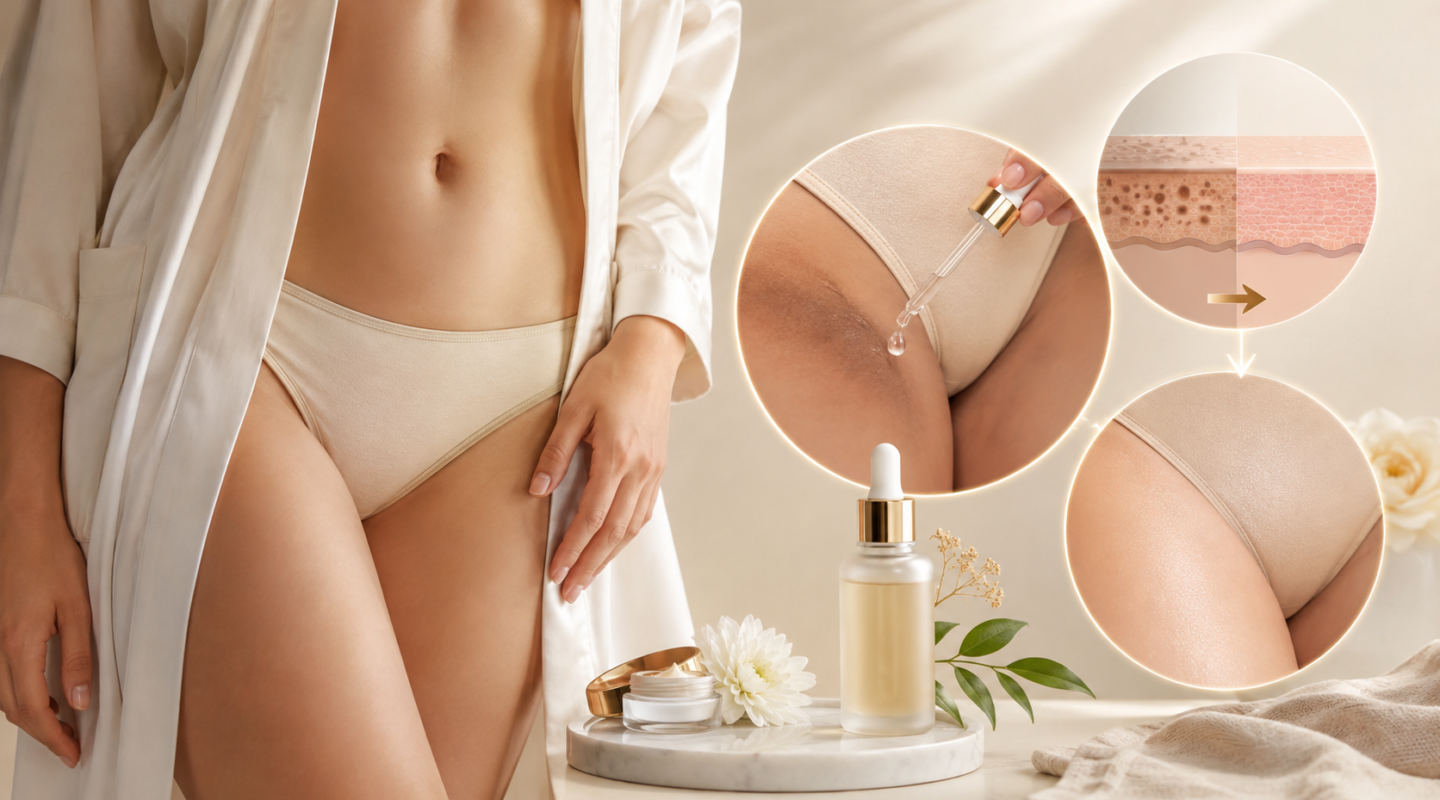
Dark or uneven skin around the intimate area is extremely common. Changes in skin tone can occur because of friction, shaving, hormonal changes, inflammation, genetics, or simple differences in natural pigmentation. Yet because the area is sensitive, trying to lighten it aggressively can sometimes make the problem worse.
That is why the goal of intimate area skin lightening should not be to make the skin unnaturally white. A better goal is to reduce excess pigmentation, improve uneven tone, and keep the skin barrier healthy.
This guide explains why intimate areas can become darker, which gentle approaches may be worth considering, what ingredients are commonly used for external skin, what products to avoid, and when professional advice may be appropriate. Because intimate skin is sensitive and pigmentation can have different causes, cosmetic skincare cannot guarantee a particular result.
- Is Dark Skin Around the Intimate Area Normal?
- What Causes Dark Intimate Areas?
- Intimate Area Skin Lightening vs. Whitening
- Can You Safely Lighten the Intimate Area?
- What Ingredients Can Help With Intimate Area Brightening?
- What Should You Avoid for Intimate Area Skin Lightening?
- How to Build an Intimate Area Brightening Routine
- How Long Does Intimate Area Skin Lightening Take?
- Can Shaving Cause Dark Intimate Areas?
- Does Exfoliation Help Dark Intimate Areas?
- Is Intimate Area Skin Lightening Permanent?
- When Should You See a Dermatologist or Healthcare Professional?
- FAQ’s About Intimate Area Skin Lightening
- Final Thoughts
Is Dark Skin Around the Intimate Area Normal?
Yes. The skin around the intimate area is often naturally darker than surrounding skin.
The vulva, groin, inner thighs, and other areas exposed to friction can have more noticeable pigmentation. Skin tone also varies naturally between individuals and can change throughout life.
Darkening does not automatically mean that the skin is dirty, unhealthy, or poorly cared for.
In fact, aggressively trying to change naturally occurring pigmentation may cause irritation. When skin becomes inflamed or injured, it can produce additional pigmentation known as post-inflammatory hyperpigmentation (PIH). This is particularly noticeable in darker skin tones.
So before starting an intimate area lightening routine, it is important to understand whether you are dealing with normal pigmentation or discoloration caused by irritation or another skin condition.
What Causes Dark Intimate Areas?
There is rarely one single explanation for intimate area discoloration. Several factors can contribute at the same time.
1. Friction
Repeated rubbing from tight underwear, clothing, exercise, or skin-to-skin contact can irritate the skin.
Continued irritation may encourage pigmentation, especially in people whose skin is prone to post-inflammatory hyperpigmentation.
Reducing unnecessary friction can therefore be just as important as choosing a brightening product.
2. Shaving and Hair Removal
Frequent shaving, waxing, or other hair-removal methods can irritate the skin.
Small cuts, razor burn, ingrown hairs, and inflammation may leave behind darker marks after the skin heals.
If you notice that discoloration became more obvious after changing your hair-removal routine, irritation may be contributing to the problem.
3. Hormonal Changes
Hormonal fluctuations can affect pigmentation. Pregnancy, for example, can cause changes in skin pigmentation in different areas of the body.
Because pigmentation can have hormonal and biological causes, topical skincare cannot always completely prevent or eliminate it.
4. Irritating Products
Perfumed washes, deodorants, harsh exfoliants, aggressive scrubs, and other irritating products can damage the skin barrier.
This matters because irritation may lead to more discoloration rather than less. The American Academy of Dermatology recommends gentle, fragrance-free skincare when treating hyperpigmentation because irritating products can contribute to dark spots.
5. Previous Inflammation or Skin Problems
Conditions that cause inflammation can leave darker pigmentation after they improve.
This is one reason treating the underlying irritation or skin condition is important before concentrating solely on skin lightening.
6. Genetics and Natural Skin Tone
Some people naturally have darker pigmentation around the groin, genital area, or inner thighs.
In these cases, skincare may improve uneven or excess pigmentation, but it may not make the area match the surrounding skin completely.
That distinction is important: brightening uneven pigmentation is different from trying to erase natural skin color.
Intimate Area Skin Lightening vs. Whitening
The words lightening, brightening, and whitening are often used interchangeably in skincare marketing, but they should not be treated as identical goals.
Intimate area brightening generally means improving dull, uneven, or excessive pigmentation so the skin looks more even.
Skin lightening generally refers to reducing the appearance of hyperpigmentation or dark patches.
Whitening can imply changing the skin dramatically from its natural tone, which is not a realistic or desirable skincare objective.
A safer approach is to focus on even-looking, healthy skin rather than achieving a specific lighter shade.
Can You Safely Lighten the Intimate Area?
Potentially, yes—but the location matters.
The skin around the bikini line, pubic region, groin, and inner thighs is not necessarily the same as the internal vaginal tissue. Products formulated for external skin should not automatically be assumed to be appropriate for internal use.
The safest approach is to use products specifically formulated and labeled for the intended external area and avoid applying cosmetic brightening products to mucosal tissue unless a qualified healthcare professional has specifically advised you to do so.
The vulvar area is particularly sensitive. Cleveland Clinic recommends gentle cleaning, avoiding irritating or scented products, and avoiding practices such as douching.
What Ingredients Can Help With Intimate Area Brightening?
There is no single “magic” intimate area lightening ingredient. Results depend on the cause of pigmentation, concentration, formulation, frequency of use, and individual skin sensitivity.
For external areas of skin, some commonly researched brightening ingredients include:
Niacinamide
Niacinamide is widely used in skincare for uneven skin tone and supports the skin barrier.
Because the intimate area can be sensitive, a well-formulated product containing a moderate concentration may be preferable to an aggressive combination of multiple actives.
Azelaic Acid
Azelaic acid is used in dermatology for several pigmentation-related concerns and inflammatory skin conditions.
It may be useful when pigmentation is associated with acne-like bumps or inflammation, although intimate-area use should be limited to appropriate external skin and carefully formulated products.
Vitamin C
Vitamin C is commonly used in products designed to improve the appearance of uneven pigmentation.
However, not every vitamin C formulation is equally gentle. Highly acidic formulas may sting sensitive skin, making formulation and tolerance important.
Alpha Hydroxy Acids
Ingredients such as lactic acid and glycolic acid can help exfoliate the outer layer of skin and improve uneven pigmentation.
But this is where people often make a mistake.
More exfoliation does not necessarily mean faster results.
Over-exfoliating sensitive skin can cause irritation, and irritation can contribute to additional pigmentation.
For intimate-area skincare, gentle formulations and controlled use are more sensible than aggressive peeling.
What Should You Avoid for Intimate Area Skin Lightening?
This is arguably more important than choosing a brightening ingredient.
Avoid harsh bleaching products
Never use household bleach or other corrosive products on your skin. The American Academy of Dermatology specifically warns against applying liquid bleach to skin to treat pigmentation.
Avoid aggressive scrubbing
Physical scrubbing does not “scrub away” pigmentation. Excessive friction can irritate the skin and potentially make discoloration more noticeable.
Avoid heavily fragranced products
Fragrance can irritate sensitive skin. Cleveland Clinic recommends fragrance-free products when irritation is a concern, particularly around sensitive skin.
Be cautious with unregulated whitening creams
Some skin-lightening products have been found to contain undeclared ingredients, including steroids or mercury. Long-term inappropriate use can cause significant skin problems.
Do not use random DIY remedies
Lemon juice, baking soda, toothpaste, hydrogen peroxide, and similar home remedies are not a sensible solution for intimate-area pigmentation.
The skin in this region does not need a stronger chemical attack. It needs a controlled, gentle approach.
How to Build an Intimate Area Brightening Routine
A simple routine is usually better than layering multiple active ingredients.
Step 1: Keep the Area Clean Without Over-Cleansing
Clean the external area gently.
Avoid excessive washing, harsh soaps, scrubbing, and fragranced products. The goal is to maintain cleanliness without repeatedly stripping or irritating the skin barrier.
Step 2: Reduce Friction
Choose breathable underwear and avoid clothing that constantly rubs against the area.
If exercise or prolonged walking creates significant friction, reducing that friction may be an important part of preventing further discoloration.
Step 3: Use One Appropriate Brightening Product
Rather than applying multiple acids, retinoids, bleaching products, and exfoliants at the same time, introduce one suitable product at a time.
Patch testing on an appropriate external area can help identify irritation before broader use.
Step 4: Moisturize When Needed
Maintaining a healthy skin barrier can reduce dryness and irritation.
A simple, fragrance-free moisturizer may be more beneficial than continually adding stronger actives.
Step 5: Be Consistent
Pigmentation generally does not disappear overnight.
The American Academy of Dermatology notes that superficial dark spots may take months to fade once the underlying cause is controlled, with deeper pigmentation sometimes lasting considerably longer.
How Long Does Intimate Area Skin Lightening Take?
This is one of the most important questions to answer realistically.
You may notice improvements in texture or overall appearance before significant pigment reduction occurs. However, meaningful pigmentation changes often require consistent care over several weeks or months.
There is no reliable method that can guarantee that naturally darker intimate skin will become dramatically lighter in seven days.
In fact, aggressive attempts to produce rapid results can backfire.
When inflammation or irritation causes pigmentation, stopping the trigger can be an essential first step. Once the skin is no longer repeatedly irritated, the discoloration may gradually become less noticeable.
Think of intimate area brightening as a gradual skin-tone management process, not an overnight transformation.
Can Shaving Cause Dark Intimate Areas?
Shaving itself does not automatically make skin permanently darker, but repeated shaving-related irritation can contribute to pigmentation.
Razor burn, small cuts, ingrown hairs, and inflammation can all create the kind of irritation that may eventually leave darker marks.
If shaving seems to be associated with worsening discoloration, consider improving shaving technique, reducing unnecessary passes over the skin, and addressing irritation rather than simply applying stronger lightening products.
Does Exfoliation Help Dark Intimate Areas?
Gentle exfoliation can sometimes help with surface roughness and uneven skin tone, but it must be approached carefully.
The intimate area is more sensitive than many other body areas. Excessive exfoliation can damage the skin barrier and trigger irritation.
That can create the opposite result from what you want.
A better strategy is to use a product designed for the intended external skin area, follow its instructions, and stop if you experience burning, persistent redness, itching, swelling, or significant discomfort.
Is Intimate Area Skin Lightening Permanent?
Not necessarily.
Even when pigmentation improves, it can return if the original trigger continues.
For example, ongoing friction, shaving irritation, inflammation, or hormonal changes may contribute to new pigmentation.
This is why successful intimate area skin lightening is not only about fading existing discoloration. It is also about identifying and reducing whatever is causing it.
The same principle applies to hyperpigmentation elsewhere on the body: controlling the underlying trigger is an important part of preventing new dark spots.
When Should You See a Dermatologist or Healthcare Professional?
Not every dark intimate area requires medical treatment.
However, it is worth getting professional advice if the discoloration:
- appears suddenly or changes rapidly
- comes with severe itching, burning, pain, swelling, sores, or discharge
- is accompanied by persistent inflammation
- does not improve after removing obvious irritants
- appears as a new, unusual, or rapidly changing patch
- is causing significant concern and you are unsure what is causing it
A healthcare professional can determine whether the issue is simple pigmentation or whether another skin condition needs treatment.
This is especially important because some conditions that look like “dark skin” may actually involve inflammation or another dermatological problem.
FAQ’s About Intimate Area Skin Lightening
Can I lighten my intimate area naturally?
Gentle skincare and reducing irritation can help improve the appearance of uneven pigmentation over time. However, there is no guaranteed natural remedy that can safely transform your natural skin tone.
Avoid DIY acids and abrasive ingredients such as lemon juice or baking soda.
What is the best product for intimate area skin lightening?
The best product depends on the cause of the pigmentation and the sensitivity of the area.
Look for a product specifically formulated for the external area you intend to treat, with gentle brightening ingredients and without unnecessary irritants or heavy fragrance.
Can I use a face brightening serum on my intimate area?
Not automatically.
A face serum may contain acids, retinoids, fragrance, alcohol, or other ingredients that are tolerated by facial skin but may irritate more sensitive external intimate skin.
Always check whether the product is appropriate for the intended area.
Can intimate area pigmentation be removed completely?
Natural pigmentation cannot always be completely removed, and discoloration caused by different factors responds differently to treatment.
A more realistic goal is to reduce excess pigmentation and achieve a more even-looking skin tone.
How can I prevent darkening after hair removal?
Reduce irritation. Use appropriate hair-removal techniques, avoid repeatedly scraping or rubbing the same area, and address ingrown hairs or razor irritation rather than immediately reaching for stronger bleaching products.
Does wearing tight underwear make intimate areas darker?
Constant friction and irritation can contribute to pigmentation in susceptible skin. Wearing comfortable, breathable clothing and reducing unnecessary rubbing may help prevent further irritation.
Final Thoughts
Intimate area skin lightening should be approached differently from ordinary facial skincare.
The most effective strategy is not necessarily the strongest serum or the fastest exfoliating treatment. It is a combination of understanding what is causing the discoloration, protecting the skin barrier, minimizing friction and irritation, and using appropriately formulated brightening products consistently.
For many people, some degree of darker pigmentation in the intimate area is completely normal. The objective should be healthier, more even-looking skin—not forcing the area to become unnaturally white.
And most importantly, patience matters. Pigmentation can take time to fade, while aggressive treatments can create more irritation and potentially more discoloration. Gentle, consistent care is usually the smarter long-term strategy.