Ever have weeks where you feel energetic and motivated, followed by days when your usual routine suddenly feels harder? If you have a menstrual cycle, changes in hormones, sleep, appetite, mood, and energy can sometimes play a role.
Cycle syncing is the idea of adjusting exercise, food, work, and self-care around the menstrual cycle. It can be a useful framework for noticing patterns and giving yourself more flexibility, but it is not a medical rulebook—and your cycle does not have to follow a perfect 28-day schedule.
- Quick Answer: What Is Cycle Syncing?
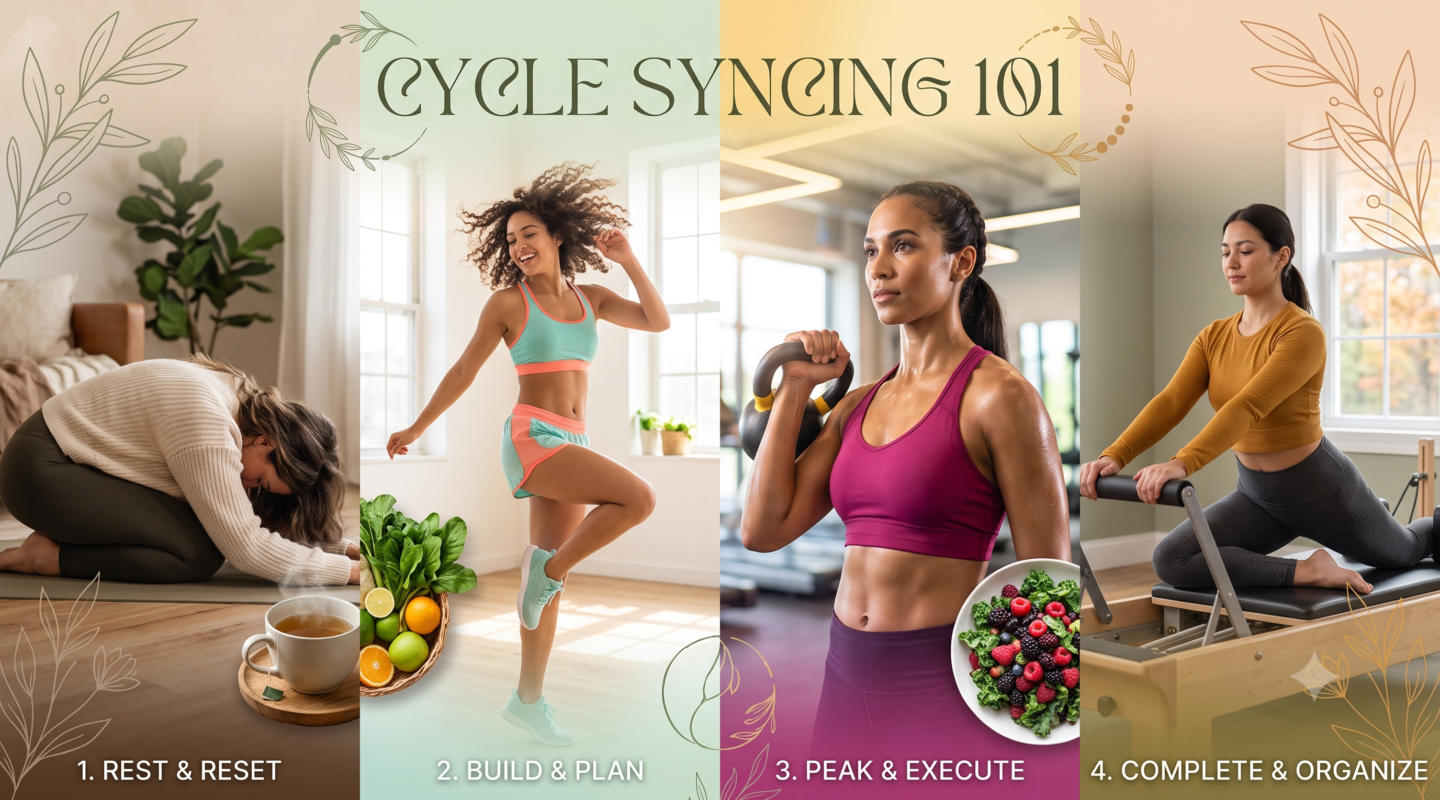
- Phase 1: Menstrual Phase — Rest, Reset, and Check In
- Phase 2: Follicular Phase — Build and Explore
- Phase 3: Ovulation — Use Your Energy If You Have It
- Phase 4: Luteal Phase — Adjust as Needed
- At-a-Glance Cycle Syncing Cheat Sheet
- Does Cycle Syncing Actually Work?
- What If Your Cycle Is Irregular?
- What If You Use Hormonal Birth Control?
- How to Try Cycle Syncing Without Overcomplicating It
- Frequently Asked Questions
- The Bottom Line
Quick Answer: What Is Cycle Syncing?
Cycle syncing means paying attention to where you are in your menstrual cycle and adapting your routines when that feels helpful. The four commonly discussed phases are menstrual, follicular, ovulatory, and luteal.
Cycle length and symptoms vary widely. Think of the phases as a framework for observation rather than fixed calendar days or instructions that everyone needs to follow.
- Menstrual phase: The period, when bleeding occurs.
- Follicular phase: Begins on the first day of the period and continues until ovulation.
- Ovulation: A relatively brief window when an egg is released.
- Luteal phase: The period after ovulation and before the next period.
Phase 1: Menstrual Phase — Rest, Reset, and Check In
During menstruation, estrogen and progesterone are relatively low. Some people feel tired, crampy, or less motivated, while others feel completely normal. There is no single “correct” menstrual experience.
How to Move
Let your symptoms and energy guide you. Gentle walking, stretching, yoga, or a normal workout can all be reasonable choices if they feel good. If cramps, fatigue, or other symptoms are significant, taking a rest day is also completely reasonable.
How to Eat
Focus on regular, nourishing meals rather than trying to follow a special menstrual-phase diet. Iron-rich foods can be particularly useful for people who lose a lot of blood during menstruation. Good options include lentils, beans, leafy greens, meat, seafood, and iron-fortified foods.
Work & Lifestyle
If your energy is lower, use this as a chance to reduce unnecessary pressure. Journaling, planning, lighter tasks, or simply keeping your normal schedule with more rest can all fit into a cycle-syncing approach.
Phase 2: Follicular Phase — Build and Explore
The follicular phase starts on the first day of your period and ends at ovulation. Estrogen generally rises during this phase, although the timing varies from person to person.
How to Move
If you notice your energy improving, you may naturally feel ready for more challenging workouts. Running, cycling, strength training, dance, or trying something new can all work. There is no need to increase intensity simply because a calendar says you are in the follicular phase.
How to Eat
Keep it simple: aim for balanced meals with protein, carbohydrates, healthy fats, vegetables, fruit, and enough fluids. There is no strong evidence that everyone needs a specific follicular-phase food list.
Work & Lifestyle
If you personally notice more energy or focus during this part of your cycle, it can be a useful time for creative work, new projects, or more demanding tasks.
Phase 3: Ovulation — Use Your Energy If You Have It
Ovulation is triggered by a hormonal surge and typically occurs once during a cycle. The exact timing is different for everyone and cannot reliably be assigned to the same calendar days every month.
How to Move
If you feel strong and energized, challenging strength sessions, faster cardio, or other higher-intensity exercise may feel good. Your cycle does not determine what you are capable of, so let your training experience and recovery guide you.
How to Eat
There is no special ovulation diet you need to follow. Prioritize adequate calories, protein, carbohydrates, fiber, and hydration to support your normal activity.
Work & Lifestyle
Some people report feeling more social or energetic around ovulation. If that pattern is true for you, you might choose this window for presentations, meetings, social plans, or other activities you enjoy doing when your energy is higher.
Phase 4: Luteal Phase — Adjust as Needed
After ovulation, progesterone rises and then falls if pregnancy does not occur. Some people notice increased appetite, changes in sleep, breast tenderness, bloating, mood changes, or PMS symptoms during the luteal phase.
How to Move
You do not have to stop exercising during the luteal phase. Continue your normal training if you feel good. If PMS symptoms or lower energy make hard sessions less appealing, reduce intensity, choose steady cardio, strength work, mobility, or walking, and give yourself more recovery time.
How to Eat
Increased hunger before a period is common. Rather than trying to fight it, build satisfying meals and snacks around protein, carbohydrates, fiber, and healthy fats. Foods containing magnesium, calcium, iron, and other nutrients can be part of a balanced diet, but no single food is a cure for PMS.
Work & Lifestyle
If you notice that concentration, mood, or energy changes before your period, use your own tracking data to plan accordingly. You may prefer quieter tasks, earlier nights, or a little more recovery time.
At-a-Glance Cycle Syncing Cheat Sheet
| Phase | What may be happening | Possible approach |
|---|---|---|
| Menstrual | Bleeding; hormones are relatively low | Rest or train according to symptoms |
| Follicular | Estrogen generally rises | Build activity if energy is increasing |
| Ovulation | Hormonal surge around egg release | Use higher energy for challenging activity if desired |
| Luteal | Progesterone rises then falls | Adjust intensity and recovery if PMS symptoms appear |
Does Cycle Syncing Actually Work?
Cycle syncing can be useful as a self-awareness tool, but the evidence does not support the idea that every person should follow a rigid four-phase diet and workout schedule. Menstrual cycles vary, symptoms vary, and research on cycle-based exercise and nutrition is still developing.
The most useful part may be the tracking itself: noticing whether your sleep, appetite, mood, recovery, or exercise performance consistently changes at a particular point in your cycle, then making practical adjustments based on your own experience.
What If Your Cycle Is Irregular?
If your periods are irregular, fixed “day 1 to day 28” schedules are especially unreliable. Instead, track symptoms such as bleeding, cramps, mood, sleep, appetite, and energy. If irregular periods are new, very frequent, unusually heavy, or concerning to you, speak with a qualified healthcare professional.
What If You Use Hormonal Birth Control?
Hormonal birth control can change or suppress the natural hormonal pattern of ovulation and the menstrual cycle. That means traditional cycle-syncing phase labels may not map neatly onto your experience.
You can still use symptom tracking and adjust exercise, food, and recovery according to how you actually feel. There is no need to force your routine into a natural-cycle template.
How to Try Cycle Syncing Without Overcomplicating It
- Track first. For two or three cycles, note bleeding, energy, sleep, appetite, mood, symptoms, and workouts.
- Look for patterns. Pay attention to changes that happen repeatedly rather than relying on one unusual month.
- Adjust one thing at a time. Try changing workout intensity, bedtime, meal timing, or workload rather than rebuilding your entire routine.
- Keep flexibility. A calendar is a guide, not a command. Your body may not follow the same pattern every month.
- Keep the basics consistent. Sleep, hydration, adequate nutrition, regular movement, and recovery matter throughout the entire cycle.
Frequently Asked Questions
Is cycle syncing based on a 28-day cycle?
Not necessarily. Twenty-eight days is often used as a convenient example, but normal menstrual cycles can be shorter or longer and can vary from cycle to cycle.
Should I exercise differently during each cycle phase?
You can adjust exercise if you notice meaningful changes in energy, symptoms, or recovery, but you do not have to. Research does not support a universal workout prescription for every menstrual phase.
Can cycle syncing help with PMS?
Some people find that tracking their cycle and adjusting sleep, exercise, nutrition, and workload helps them manage symptoms. However, cycle syncing is not a proven treatment for PMS. Persistent or severe symptoms deserve medical advice.
Does cycle syncing work if I have irregular periods?
You can still track symptoms and look for personal patterns, but fixed day-based phase schedules are less useful. If your periods are unusually irregular or have changed significantly, consider discussing it with a healthcare professional.
Can I cycle sync while using hormonal birth control?
You can use symptom tracking and flexible routines, but hormonal birth control may change the natural hormonal pattern, so the traditional four-phase model may not accurately describe what is happening physiologically.
How long should I try cycle syncing?
Give yourself at least two or three cycles to look for patterns, especially if you are tracking symptoms. Avoid judging the approach based on a single month.
The Bottom Line
Cycle syncing is best treated as a flexible framework for understanding your own patterns—not as a rule that your body must obey. Your cycle may influence how you feel, but it does not define what you can or cannot do on a particular day.
Track what actually happens, keep your routine adaptable, and make small changes when they genuinely help. That approach is more sustainable than trying to force every month into a perfect four-phase schedule.